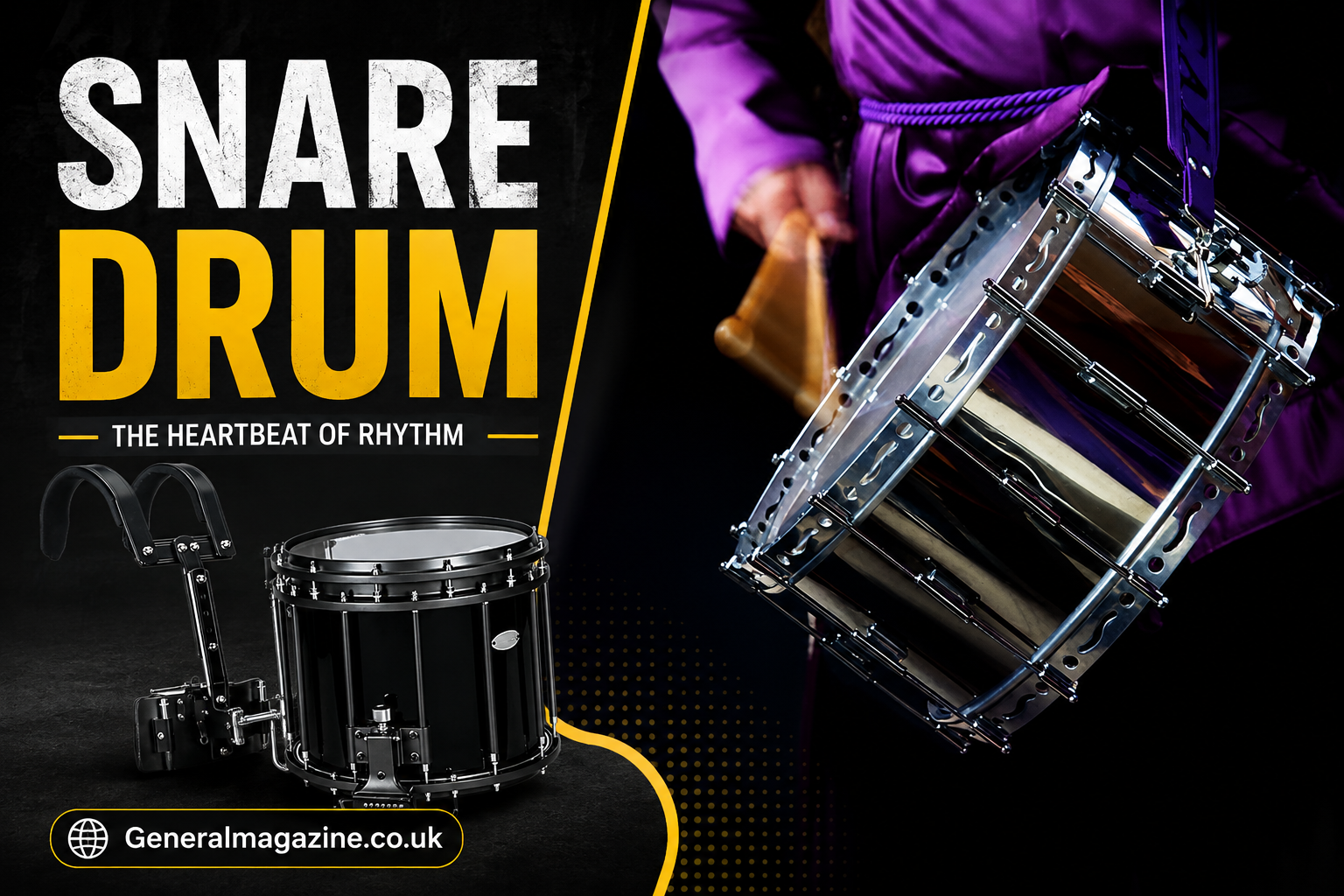
What Is a Snare Drum?
A snare drum is one of the most recognizable percussion instruments in modern music. Its distinctive sound comes from a set of wires or synthetic strands stretched across the bottom head. When the batter head is struck, the vibration activates the snares and creates the sharp, buzzing response that separates the instrument from a tom or other drum.
You can find snare drums in concert bands, orchestras, marching bands, drumlines, rock groups, jazz ensembles, schools, and recording studios.
But getting a great sound is not simply about hitting the drum harder. Head selection, shell construction, snare tension, tuning, stick choice, playing technique, and room acoustics all influence the final result.
That is why learning how to tune a snare drum properly can make a surprisingly large difference—even with an affordable instrument.
How a Snare Drum Produces Its Sound
A snare drum generally has two heads:
- Batter head: The top surface struck by the player.
- Snare-side or resonant head: The thinner bottom head underneath the snares.
The shell, heads, hoops, tension rods, lugs, and snare mechanism work together as one acoustic system.
According to Yamaha’s drum education material, striking the head creates vibrations that interact with the air inside the shell and transfer energy to the bottom head and shell. The tension of the heads also changes the drum’s resonance, sustain, volume, and tonal character.
This explains why two visually similar snare drums can sound completely different. & more blogs to see digital .
The Main Parts
| Part | Function |
|---|---|
| Batter head | Playing surface |
| Snare-side head | Vibrates with the snares |
| Shell | Main resonating body |
| Snares | Create the characteristic buzz |
| Strainer | Engages/disengages the snares |
| Tension rods | Adjust head tension |
| Lugs | Hold the tension rods |
| Hoops | Secure and tension the heads |
| Butt plate | Holds the opposite end of the snares |
Shells may be made from wood, metal, aluminum, or other materials, while snares can use wire, cable, gut, or synthetic materials.
Types of Snare Drums
Although the basic principle remains the same, snare drums are designed for different musical environments.
Concert Snare Drum
Concert snares are commonly used in orchestras, concert bands, wind ensembles, and educational settings.
They tend to prioritize controlled articulation, balanced tone, sensitivity, and musical expression. Players may use different sticks, brushes, rods, or other implements depending on the composition.
Vic Firth’s Concert Snare Drum education program covers instrument selection, maintenance, tuning, stick selection, and playing techniques.
Drum Set Snare Drum
The drum-set snare is typically positioned between the player’s legs and provides much of the rhythmic backbeat in rock, pop, funk, blues, jazz, and other styles.
The ideal sound depends heavily on genre. A jazz player may prefer a more open and sensitive response, while a rock drummer might want stronger attack and projection.
Marching Snare Drum
A marching snare drum is specifically designed for outdoor projection, powerful articulation, durability, and ensemble precision.
Modern marching drums often use high-tension heads, including Kevlar-type materials. Yamaha notes that these heads can support the high-tension environment of competitive marching percussion and provide strong articulation.
Marching snares are therefore not simply deeper versions of ordinary drum-set snares. Their construction and tuning approach can be substantially different.
Marching Snare Drum vs Regular Snare Drum
| Feature | Regular Snare | Marching Snare |
| Primary environment | Indoor music | Outdoor/indoor marching |
| Sound goal | Versatility | Projection and articulation |
| Head tension | Moderate to high | Often very high |
| Head materials | Mylar/coated/clear varieties | Often high-tension synthetic/Kevlar-type |
| Playing style | Broad range | Rudimental and ensemble-focused |
| Projection | Moderate to strong | Very strong |
| Typical use | Rock, jazz, concert, recording | Marching bands and drum corps |
The difference became particularly important as marching organizations adopted high-tension synthetic heads. Yamaha’s historical overview notes that Kevlar and similar laminated heads allowed marching snares to be tuned considerably higher, which also required drum designs capable of handling the additional stress.
Why Marching Snares Sound So Different
The combination of high tension, specialized heads, shell construction, snare systems, and powerful marching sticks produces a bright, immediate sound.
Yamaha describes marching snares as instruments designed for precise articulation, powerful projection, and durable performance.
How to Tune a Snare Drum Properly
One of the most searched questions among drummers is how to tune a snare drum properly.
The important point is that there is no single universal tuning that works for every player. Your preferred sound, drum, head combination, genre, and playing environment all matter.
Step 1: Inspect the Drum
Before tuning, check:
- Head condition
- Bearing edges
- Hoops
- Tension rods
- Lugs
- Snare wires
- Strainer mechanism
Damaged, stretched, or badly worn heads can make tuning unnecessarily difficult. Yamaha recommends checking head condition and cleaning the heads, hoops, and bearing edges before tuning.
Step 2: Seat the Head
Place the head correctly on the shell and install the hoop.
Finger-tighten each tension rod evenly. If the head has wrinkles, gently work around the surface rather than immediately applying large amounts of tension.
Seating the head correctly gives you a more stable starting point.
Step 3: Tighten Opposite Tension Rods
Use a cross-pattern rather than moving around the drum in a circle.
For example:
- Tighten one rod.
- Move to the rod directly opposite it.
- Continue across the drum.
- Gradually increase tension.
Yamaha specifically recommends tightening opposite pairs to help keep the head evenly tensioned and avoid wrinkles.
Step 4: Check for Even Pitch
Lightly tap the head close to each tension rod.
You are listening for consistency.
If one area sounds noticeably higher or lower than another, make small adjustments rather than large turns.
This is one of the most important tuning habits because uneven tension can cause inconsistent tone across the playing surface.
Step 5: Tune the Bottom Head
The snare-side head has a major influence on sensitivity and response.
Yamaha notes that tuning the bottom head higher than the batter head can increase articulation and crispness.
However, avoid blindly copying a specific pitch from another drummer. The right balance depends on the drum and the sound you want.
Step 6: Adjust the Snare Wires
Engage the snares and listen
If the snares are too loose, the response may become sluggish or excessively rattly. If they are too tight, the drum can lose sensitivity and sound choked.
Make small adjustments and test the drum after each change.
Step 7: Play at Different Dynamics
Don’t judge the tuning only by loud hits.
Test:
- Soft taps
- Ghost notes
- Rimshots
- Accents
- Rolls
- Low-volume passages
A good tuning should respond across a useful dynamic range.
Snare Drum Sheet Music and Rudiments
Learning snare drum sheet music is essential for students, concert percussionists, marching players, and anyone who wants to progress beyond basic beats.
Snare notation commonly communicates rhythm, sticking, accents, rolls, flams, drags, and other performance instructions.
Start With Basic Rhythms
Beginners should become comfortable reading:
- Whole notes
- Half notes
- Quarter notes
- Eighth notes
- Sixteenth notes
- Rests
- Accents
- Basic rolls
Then move toward more complex rudimental vocabulary.
The Percussive Arts Society’s traditional list represented in Vic Firth’s educational material contains 40 essential snare drum rudiments, including single-stroke rolls, double-stroke rolls, paradiddles, flams, drags, and ratamacues.
Practice With a Metronome
Start slowly.
For example, if a passage feels difficult at 120 BPM, practice it at 60–70 BPM until the notes are even. Increase the tempo gradually rather than trying to play the final speed immediately.
Vic Firth’s marching education resources also emphasize tempo control, timing, stroke consistency, rolls, flams, and other foundational skills.
For marching players, official educational resources can also provide actual snare parts and play-along material. Vic Firth’s current marching education archive includes snare sheet music from drum corps programs.
Why This Matters
A snare drum is often treated as a simple percussion instrument, but its role is much bigger.
In an ensemble, the snare can define rhythmic clarity, articulation, accents, dynamics, and stylistic character.
For a marching ensemble, small differences in timing or sound can become obvious when many players perform the same passage.
For a concert percussionist, sensitivity and tonal control may be more important than sheer volume.
For a drum-set player, the snare often determines the character of the backbeat.
In other words, good technique and good tuning are not cosmetic improvements—they directly affect musical communication.
Practical Case Study: Fixing a Dull-Sounding Snare
Consider a beginner whose snare sounds flat and lifeless.
Initial problem
The player notices:
- Weak articulation
- Excessive ring
- Uneven response
- Poor sensitivity during soft playing
Troubleshooting process
First, inspect the head and bearing edge. Next, check whether the head is evenly tensioned. Then tune the bottom head carefully and adjust the snare wires in small increments.
After each adjustment, test soft notes and rimshots.
This approach is more reliable than simply tightening every tension rod because it isolates the variables affecting the sound.
The result should be a more controlled response without sacrificing sensitivity.
Pros and Cons of Different Snare Drum Setups
Higher-Tension Setup
Pros
- Strong articulation
- Fast response
- Excellent projection
- Useful for marching
Cons
- Can feel less forgiving
- May reduce certain low-frequency qualities
- Requires compatible hardware and heads
Lower-Tension Setup
Pros
- Fuller and deeper tone
- Often comfortable for softer styles
- Can provide more tonal body
Cons
- May become less articulate
- Can produce unwanted overtones
- May not project as strongly
Coated Head
Pros
- Warm response
- Useful for brushes
- Traditional sound
Cons
- Can wear with heavy playing
Clear or Synthetic Head
Pros
- Strong attack
- Bright response
- Durable options available
Cons
- May sound less warm depending on the setup
Yamaha similarly notes that coated heads can provide warmer sounds and work well with brushes, while clear heads tend to emphasize attack and brightness. Single-ply and double-ply designs also produce different combinations of resonance, warmth, articulation, and durability.
Expert Recommendations
For beginners, prioritize consistency over complexity.
- Learn proper grip and basic strokes before chasing advanced tricks.
- Practice rudiments slowly with a metronome.
- Tune every tension point evenly.
- Learn to identify the sound of an over-tightened or uneven head.
- Replace damaged heads rather than trying to compensate through tuning.
- Use drumsticks appropriate to your playing environment.
- Marching players should use heads and drums designed for high-tension applications.
- Record yourself occasionally so you can hear timing and dynamic inconsistencies.
- Practice both soft and loud passages.
- Learn to make small tuning adjustments rather than dramatic changes.
For marching percussion specifically, Yamaha recommends checking individual tension points and maintaining consistent snare-strand tension; its marching guidance also stresses practicing with well-tuned instruments rather than waiting until performance day.
Common Snare Drum Mistakes to Avoid
1. Tightening Everything Too Quickly
Large adjustments can make the head uneven. Work gradually.
2. Ignoring the Bottom Head
The snare-side head is critical to sensitivity and articulation.
3. Over-Tightening the Snares
More tension does not automatically mean a better sound.
4. Practicing Only Fast
Speed without control can reinforce inconsistent technique.
5. Ignoring Dynamics
A drummer who can play loudly but cannot control soft notes still has a significant technical gap.
6. Using the Wrong Head
A marching snare designed for high tension should not be treated like an ordinary concert or drum-set snare. Kevlar-type marching heads can place substantial demands on the instrument.
Maintenance Tips
A few minutes of maintenance can prevent larger problems.
- Wipe the drum after heavy use.
- Inspect tension rods regularly.
- Check the snare wires for damage.
- Keep the strainer functioning smoothly.
- Inspect the heads for dents or cracks.
- Clean the bearing edges when replacing heads.
- Store the instrument in an appropriate case.
- Avoid unnecessary impact on hoops and hardware.
Marching players should pay particular attention to loose tension rods and transport protection because high-tension instruments experience demanding conditions.
Conclusion
The snare drum may look straightforward, but its sound and performance depend on a surprisingly detailed combination of tuning, heads, shell construction, snare tension, technique, and musical context.
Whether you’re learning basic snare drum sheet music, preparing for a marching ensemble, improving rudiments, or trying to understand how to tune a snare drum properly, the best approach is to make small, controlled improvements and listen carefully to the result.
Start with even tuning, develop clean fundamentals, practice with a metronome, and learn how your particular drum responds.
FAQs
What is a snare drum used for?
A snare drum is used to create rhythmic patterns, accents, rolls, backbeats, and distinctive buzzing percussion sounds. It appears in drum sets, concert bands, orchestras, marching ensembles, drumlines, and many other musical settings.
What is a marching snare drum?
A marching snare drum is designed for marching percussion and emphasizes projection, articulation, durability, and ensemble precision. Many modern marching snares use specialized high-tension heads.
How do you tune a snare drum properly?
Start with a good-condition head, seat it correctly, finger-tighten the tension rods, then gradually tighten opposite rods in a cross-pattern. Check the pitch around the head, tune the bottom head appropriately, and adjust the snares gradually.
Should the bottom snare head be tighter than the top?
It can be. A tighter bottom head may improve articulation and crispness, but the ideal relationship depends on the instrument and desired sound. Yamaha specifically identifies a slightly higher bottom-head tension as one approach for increasing articulation.
What are snare drum rudiments?
Rudiments are foundational sticking and rhythmic patterns used to develop coordination, control, articulation, and speed. The widely used Percussive Arts Society framework includes 40 essential snare drum rudiments.
Where can I find snare drum sheet music?
Educational publishers, percussion organizations, drum instructors, and reputable manufacturer education sites provide exercises and sheet music. Vic Firth’s marching education resources, for example, include downloadable snare parts and play-along material.
Why does my snare drum sound bad?
Common causes include uneven head tension, damaged heads, incorrect snare tension, poor head seating, worn snare wires, unsuitable tuning, or an acoustic environment that exaggerates certain frequencies.
How often should I tune a snare drum?
Tune whenever the drum’s response or tone changes noticeably. Heavy players and marching ensembles may need to check tuning much more frequently than casual players.
Can you use a marching snare as a regular snare?
Technically, it can be used in other contexts, but it may not provide the tonal response or feel expected from a concert or drum-set snare. Marching instruments are designed around different priorities, particularly projection and high-tension articulation.
In Short
- A snare drum creates its characteristic buzz through snares positioned beneath the bottom head.
- Concert, drum-set, and marching snare drum designs serve different musical purposes.
- High-tension marching heads can deliver strong projection and articulation but require compatible instruments.
- Proper tuning starts with even head tension.
- Tightening opposite tension rods helps keep the head balanced.
- The bottom head and snare-wire tension are just as important as the batter head.
- Snare drum sheet music helps players develop rhythmic reading and rudimental technique.
- The 40 essential rudiments provide a strong foundation for serious snare players.
- Practicing slowly with a metronome is one of the most effective ways to improve consistency.
- Maintenance, tuning, and technique should be treated as parts of the same skill set.