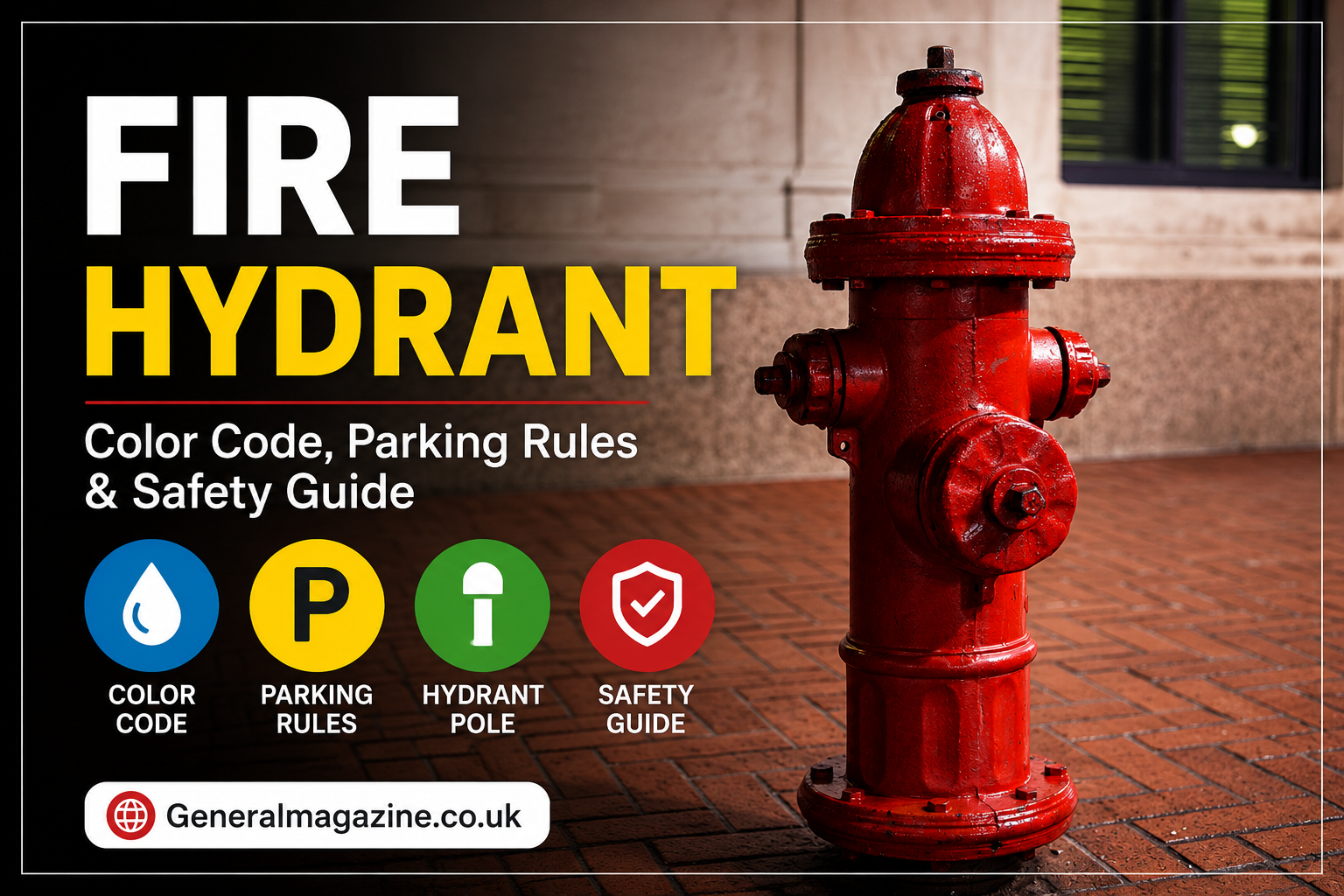
Fire Hydrant
A fire hydrant is a connection point between a municipal or private water supply and firefighting equipment. When firefighters arrive at a structure fire, they can connect hoses to an accessible hydrant and draw water from the distribution system. Although a fire hydrant may look like an ordinary metal pole beside the road, it is an important part of a community’s emergency infrastructure. Its location, visibility, outlet configuration, water pressure, and available flow can all affect firefighting operations.
For U.S. homeowners, drivers, property managers, and business owners, understanding hydrant markings and parking restrictions can prevent expensive tickets while, more importantly, keeping emergency access available. The National Fire Protection Association’s guidance on public hydrant markings uses colors to communicate hydrant capacity, while also recognizing that local jurisdictions may adopt their own marking systems.
Why Fire Hydrants Matter
During a fire, firefighters need a reliable water source that can be reached quickly. A vehicle parked directly in front of a hydrant can turn an immediately usable water connection into an obstruction.
The U.S. Fire Administration’s water-supply guidance recommends keeping obstructions away from installed hydrants and emphasizes visibility from approaching fire apparatus. Its guidance also discusses positioning hydrant outlets so firefighters can make hose connections efficiently. This is why fire hydrant regulations are about much more than parking convenience.
A few feet of additional clearance can make a major difference when firefighters are working under pressure.& more blogs to see fresh .
Fire Hydrant Color Code Explained
One of the most searched questions about hydrants is: What does the fire hydrant color code mean?
Under the NFPA 291 color classification described for public hydrants, the tops and nozzle caps can communicate the hydrant’s rated water-flow capacity:
| Color | NFPA Class | Rated Flow |
|---|---|---|
| Light blue | Class AA | 1,500 gallons per minute or more |
| Green | Class A | 1,000–1,499 GPM |
| Orange | Class B | 500–999 GPM |
| Red | Class C | Below 500 GPM |
These colors are intended to help firefighters quickly understand available hydrant capacity. NFPA documentation also recommends reflective-type paint for improved nighttime identification.
Light Blue Fire Hydrant
A light-blue hydrant top or cap represents the highest flow classification in the NFPA color scheme described above: Class AA.
That means the hydrant is rated at 1,500 GPM or greater under the classification system.
Green Fire Hydrant
Green indicates Class A, representing a rated flow of 1,000 to 1,499 GPM.
Orange Fire Hydrant
Orange represents Class B, with a rated flow of 500 to 999 GPM.
Red Fire Hydrant
Red represents Class C, indicating a rated flow of less than 500 GPM under this classification.
Why Fire Hydrant Colors Can Differ
Here’s an important point: you should not assume that every fire hydrant in the United States follows exactly the same color system.
Local authorities and water departments can establish hydrant-marking requirements. NFPA material specifically recognizes that jurisdictions may have their own painting requirements, and private hydrants can also be marked differently. Therefore, if you are trying to determine the actual capacity or operational status of a particular hydrant, check with the local fire department, water utility, or authority having jurisdiction rather than relying only on paint color.
What Is a Fire Hydrant Pole?
The phrase fire hydrant pole is sometimes used informally to describe the upright body or barrel of a fire hydrant.
A traditional above-ground hydrant consists of a vertical barrel with one or more outlets, caps, a main operating mechanism, and a connection to an underground water main.
The exact design depends on climate and local infrastructure.
Dry-Barrel Fire Hydrants
Dry-barrel hydrants are commonly used in areas where freezing temperatures can be a concern. The main valve is located below the frost line, helping prevent water from remaining in the exposed barrel. The U.S. Fire Administration describes dry-barrel hydrants as frost-proof hydrants and explains their underground valve arrangement.
Wet-Barrel Fire Hydrants
Wet-barrel hydrants are generally associated with climates where freezing conditions are not a major concern. Their construction allows water to remain in portions of the hydrant. The important takeaway is that the “pole” you see above ground is only the visible portion of a larger water-supply system.
How Close Can You Park to a Fire Hydrant?
This is one of the most important questions for U.S. drivers.
There is no single nationwide parking distance that automatically applies in every location. Local and state laws control. However, 15 feet is a common rule.
For example, California prohibits parking within 15 feet of a fire hydrant or fire-station driveway, while Michigan law also prohibits parking within 15 feet of a fire hydrant. New York City likewise prohibits parking within 15 feet of either side of a hydrant. However, the rule is not universal. Vermont, for example, currently specifies six feet for standing or parking near a fire hydrant under the cited state statute.
The Practical Rule for Drivers
If you are unsure about the local requirement:
- Look for posted parking signs.
- Check your state’s vehicle code.
- Check city or municipal parking regulations.
- Leave generous clearance around the hydrant.
- Never block the hydrant itself, even if you believe your vehicle is technically outside the minimum distance.
The safest approach is to treat the hydrant as an emergency-access zone rather than simply measuring the minimum legal distance.
Why Fire Hydrant Clearance Is Important
Firefighters need physical access to connect hoses, operate valves, and position equipment.
USFA guidance recommends that there be no obstructions within 10 feet of an installed fire hydrant, including objects such as signs, utility poles, trees, fences, and shrubbery.
Parking rules can establish a different legal distance, so don’t confuse operational guidance with the parking law in your jurisdiction.The underlying principle is simple: a hydrant that firefighters cannot quickly reach is a serious emergency-access problem.
A 2025 FDNY incident illustrates the real-world consequences. The department reported that firefighters encountered blocked hydrants during responses to fatal fires in New York City and emphasized that blocked hydrants can delay firefighting operations.
Types of Fire Hydrants
| Type | Typical Use | Main Characteristic |
| Dry barrel | Cold climates | Main valve below frost line |
| Wet barrel | Warmer climates | Water remains in the barrel |
| Private hydrant | Private property | Serves a private fire-protection system |
| Public hydrant | Streets/public areas | Connected to public water infrastructure |
| Flush hydrant | Areas with clearance constraints | Located near or below ground level |
The type of hydrant affects maintenance, operation, visibility, and installation requirements.
Pros and Cons of Fire Hydrants
Pros
- Provide rapid access to water for firefighting.
- Support fire department operations.
- Help protect homes, businesses, and public infrastructure.
- Can provide firefighters with information about available water capacity through standardized markings.
- Form an important part of community fire-protection infrastructure.
Cons
- Require regular inspection and maintenance.
- Can be damaged by vehicles.
- Can become difficult to access because of landscaping, snow, construction, or parked vehicles.
- Color markings can be confusing when local standards differ.
- Improper parking near hydrants can result in fines or towing.
Why This Matters
A fire hydrant is not simply a piece of roadside equipment.It is an emergency connection that firefighters may need within seconds of arriving at a fire. Keeping hydrants visible and accessible can help reduce delays during an emergency.
For drivers, the lesson is straightforward: don’t park close enough to a hydrant that you could prevent firefighters from using it.
For homeowners and property managers, the responsibility goes further. Landscaping, fencing, signs, storage items, snow, construction materials, and other objects should not interfere with hydrant access.
Expert Recommendations
For Drivers
- Learn your city’s hydrant parking rule.
- Don’t rely exclusively on painted curbs.
- When in doubt, leave more space.
- Never assume that a hydrant is inactive because it looks old or unpainted.
- Check signs and local regulations before parking.
For Homeowners
Keep vegetation and landscaping from concealing the hydrant. Avoid installing fences, structures, decorative walls, or other obstacles that interfere with access.
For Property Managers
Maintain a documented inspection routine for private hydrants and coordinate with the appropriate fire-protection professionals and local authority.
For Content Creators and Researchers
When explaining a fire hydrant color code, always identify the standard or jurisdiction being discussed. This prevents readers from assuming that a color has exactly the same meaning everywhere.
Common Fire Hydrant Mistakes to Avoid
Mistake 1: Assuming every red hydrant means low flow
Not necessarily. Color systems can vary by jurisdiction.
Mistake 2: Assuming the 15-foot rule applies everywhere
Fifteen feet is common, but state and local laws differ. California and Michigan use 15 feet, while Vermont’s cited statute uses six feet.
Mistake 3: Blocking the hydrant with landscaping
An unobstructed hydrant is much easier for firefighters to locate and use.
Mistake 4: Measuring only from the front
Some regulations specify clearance on both sides. New York City, for example, explicitly states that parking is prohibited within 15 feet on either side.
Mistake 5: Treating a hydrant as ordinary street furniture
A hydrant is emergency infrastructure. Accessibility should take priority over convenience.
Conclusion
A fire hydrant may look simple, but it plays a critical role in emergency response. Understanding the fire hydrant color code, recognizing the purpose of the hydrant pole, and knowing local parking restrictions can help drivers, homeowners, and businesses avoid mistakes that could interfere with firefighters.
Most importantly, don’t assume that one rule applies everywhere. Hydrant colors, parking distances, and marking requirements can be determined by state and local authorities.
Before parking near a hydrant, check the regulations in your city or state and give emergency crews plenty of room to work.
FAQs
How close can you park to a fire hydrant?
The answer depends on your state and local jurisdiction. Fifteen feet is a common U.S. requirement, including in California, Michigan, and New York City, but other jurisdictions use different distances.
What does a blue fire hydrant mean?
Under the NFPA 291 public-hydrant color classification cited above, a light-blue top or cap indicates Class AA, associated with a rated flow of at least 1,500 GPM. Local marking systems can differ.
What does a red fire hydrant mean?
Under the NFPA classification, red indicates Class C, representing a rated flow below 500 GPM. However, local jurisdictions may use different color systems.
What does a green fire hydrant mean?
Under the cited NFPA color classification, green indicates Class A, with a rated flow of 1,000–1,499 GPM.
What does an orange fire hydrant mean?
Orange corresponds to Class B in the cited NFPA scheme, representing a rated flow of 500–999 GPM.
What is a fire hydrant pole?
“Fire hydrant pole” is generally an informal description of the visible upright barrel or body of an above-ground hydrant. The complete hydrant also includes valves, outlets, caps, and underground connections.
Can I park in front of a fire hydrant if I stay in my car?
Do not assume this is legal. Rules and exceptions vary considerably by jurisdiction. For example, New York City has specific exceptions for certain occupied passenger vehicles under particular conditions, while the general rule prohibits parking within 15 feet.
Can landscaping block a fire hydrant?
It should not. USFA guidance recommends keeping obstructions away from installed hydrants, including trees, shrubs, fences, signs, and utility poles.
Are all fire hydrants connected to public water?
No. Public hydrants are typically associated with public water systems, while private hydrants can serve private fire-protection systems.
Why are fire hydrants painted different colors?
Color can communicate information such as water-flow capacity. However, the exact meaning depends on the marking standard adopted by the relevant jurisdiction or authority.
In Short
- A fire hydrant provides firefighters with access to a water supply during emergencies.
- The fire hydrant color code described by NFPA uses light blue, green, orange, and red to indicate different flow-capacity classes.
- Color systems can vary, so local requirements should always be checked.
- A fire hydrant pole generally refers to the visible upright body or barrel of the hydrant.
- Fifteen feet is a common parking restriction, but it is not universal across the United States.
- California, Michigan, and New York City all use 15 feet in the cited rules, while Vermont uses six feet in its cited statute.
- Keeping hydrants clear of vehicles, landscaping, construction materials, and other obstructions improves emergency access.